news
Amstrad Cent Pour Cent #50 & Fanzine GX #1: impressions
I recently came across two efforts that are close to my heart, and I wanted to share what I made of them.

A new issue of Amstrad Cent Pour Cent, picking up the codes of the original, came out earlier this year. The wager DarkSteph and his team took on strikes me as well won: the editorial team knows what is going on in the Amstrad community, the articles are for the most part interesting and to the point, and technically solid. The sometimes volatile tone that people were happy to attribute to the original ACPC is there, and the whole is dressed with small, funny, offbeat illustrations — some of them drawn by hand! — and now and then a straight lift from a period advertisement.
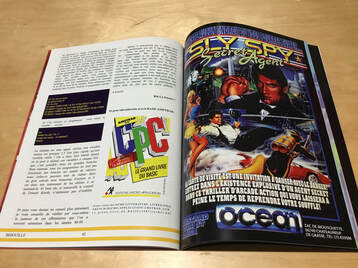
There are a few things that could be better, to my eye: since a real printing service is being used, I would have gone for paper closer to a newspaper than for glossy stock. I would also have liked more variety in the articles: video games and demos take the front row, and an “applications” angle is missing (a piece on the Orgams assembler would be in the best possible taste!). Finally, I note the conspicuous absence of ACPC’s “side” articles, the ones that used to entertain us outside our own hobby, through presentations of music albums, of events, or of coming technology not to be missed.
CONCLUSION: overall, and despite the few imperfections above, I am very satisfied with this effort. It is big, it is professional, and I am a certain reader of the issues to come! To order issue 50, it happens here.

I also had the pleasure of discovering Fanzine GX this year. This time we step a little further into amateurism, with printing that is decent enough and in full colour, despite means one guesses are limited. As it stands the magazine concentrates on Amstrad’s console alone, the GX-4000. The content is strictly video-game oriented, taking in news, features, interviews, reviews of homebrew games and a few games released commercially for the platform.
In all honesty, I surprised myself by reading the magazine from cover to cover: it turned out to be very full and above all very pleasant, even though as a programmer I am not necessarily its audience. The small illustrations here and there make it enjoyable to read. The articles dip now and then into blind fanaticism and positivity, without it becoming a nuisance. The reviews struck me, for the most part, as fair and critical.

This first issue let me see the GX-4000 from another angle, because it is dealt with for what it is — a console with a gamepad — and less as a kind of lopsided little brother to the Amstrad Plus computer. But that is exactly where my criticism lands. I was surprised to see that Oncle Ced and his team deliberately chose to ignore the hardware extensions, which would have let them talk about the C4CPC (a miniSD card reader for the GX), Roudoudou’s Bubble Quest, or Golem13’s 128 KB version of Ghosts’n’Goblins, which does — or will — run on a real Amstrad Plus cartridge. With a first issue already covering close to 50% of the console’s commercial catalogue, I am rather afraid the team will run short of ideas after a few numbers.
CONCLUSION: here again, I am won over. It is far, very far even, from my favourite Amstrad reading, and yet it works. The whole thing reminds me of the good atmosphere of the 1994 fanzines, which tried at all costs to keep the Amstrad machines afloat, long dead and buried though they were. To order the first issue, it happens here.