article
Interview Hervé Lange
This interview first appeared in March 2011 on the Phenix Informatique website, which has since become Amstrad.eu. It is reproduced here in full, translated from the French.
Hello Hervé, could you introduce yourself first?
Hello. First of all, if you will allow me, I would define myself as someone passionate about interactivity. Although mainly turned towards video games, my path has broadened over the last few years. Good at drawing — it runs in the family — but also fascinated by machines, I very quickly found myself facing a difficult choice between those two disciplines. I decided not to choose, and instead to practise both, and above all to make them complement one another through video games. To this day I remain fascinated by the possible interactions between Art and Technique, in every dimension.
Afterwards, my stubbornness in trying to understand the mechanisms that let things be “interactive” finally won out, and it was towards the technical side that I turned. After about ten years working as an independent creator of video games on home computers for companies like France Logiciels and Ubi Soft (Fer & Flamme, B.A.T), I eventually founded my own company with my team-mates of the time: Haiku Studios, aimed mainly at the CD-ROM and its storage capacity, extraordinary for the period.
We made very audiovisual games that way, for major industry names such as Philips Media, Virgin and Sony / Psygnosis. When the contraction of the late 1990s got the better of Haiku — as it did of a good many French video game companies — I turned to authoring software, and chiefly to storytelling tools. For instance I was co-author of the Mendel3D technology for the company Duran Duboi, used in an internet suite for web developers, in a yacht racing game (the first Virtual Skipper) and in a 3D storyboarding tool for Enki Bilal’s film Immortal, ad vitam.
More recently I was a co-founder of the company xtranormal, where I led the research and development of the online Text-to-Movie technology, which makes it very easy to produce short films simply by writing dialogue. I currently work for Behaviour Interactive — an independent video game company — as technical director for online games. So I take part in the creation of massively multiplayer virtual worlds, mainly for children.
A few years ago I decided to travel a little and then to settle in Canada, where I now live with my partner and my two small daughters. It is a choice I do not regret. Canada, and Québec in particular, is a wonderful country that has managed to keep a pioneering spirit — a spirit that suits my own personality entirely.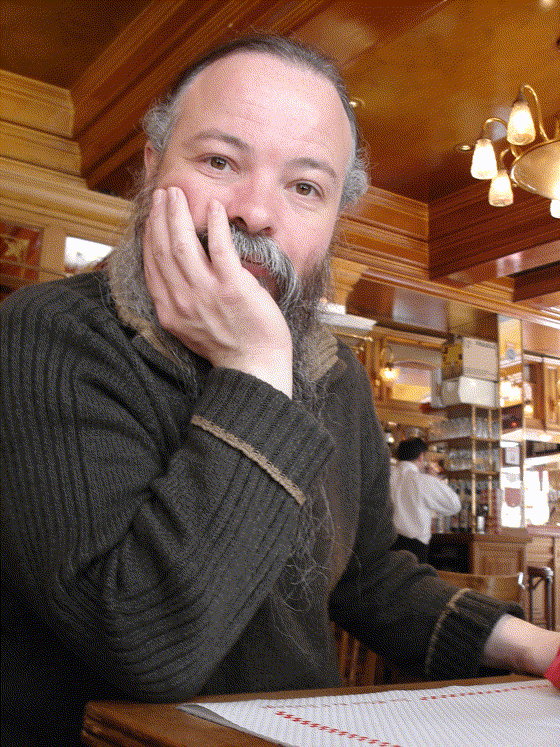
When did you discover the Amstrad CPC?
It was late 1984, I think. I was an amateur developer at France Logiciels (FL), a small video game company run by Philippe Derambure. I had already written a few personal programs and games on the Oric 1, and I had met Philippe in a computer shop in Paris — Vismo, for the nostalgic — while buying a printer, because my programs were getting bigger. Philippe was setting up FL and looking for developers. I was a student, summer was coming, and I thought: why not.
I remember Philippe taking out his notebook to write down my address, and that it was already full of names. I told myself I had a fair bit of competition. I worked like a madman through the school holidays and released Le Secret de Kaïpur: a text adventure, but with vector graphics, on the Oric 1 and then the Atmos. When Philippe and I met again in September, I was more or less the only one who had actually made something, and to sign the contract I brought him the complete listing of the game as proof! We finished the game together — one of my best memories of that time — and even though we only sold 500 copies, I was happy and I could buy myself a colour monitor. I had gained a friend, too. Later it was Philippe who bought an Amstrad CPC and handed it to me so I would make him another game: that was Le Bagne de Nepharia.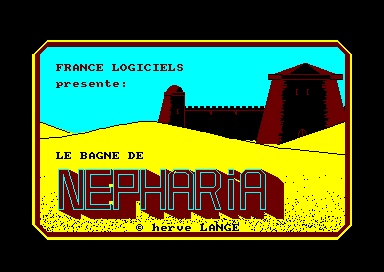
It was an opportunistic commission and I had to do it quickly, in two months, around December 1985. We still sold 2000 copies. I was quickly delighted to have a machine far superior to the Orics, and I was itching to make something more substantial. At the time there was the Apple IIe — the computer of the “professionals”, those who could also afford a more expensive machine — and I thought it was high time a real RPG arrived on the Amstrad: one on a par with an Ultima, but using the CPC’s graphics on top of that. That became Fer & Flamme. Philippe had to close FL and I found myself with the project and no publisher. I met Chip, then Ubi Soft. The first told me to come back when my game was finished; the second was ready to publish it if I replaced my keyboard interface with joystick-driven icons, as in Zombi. I went with Ubi Soft. That was in 1986.
Had you been in contact with computers before? How, and with which machines?
First of all my father worked in the computing department of a large Parisian bank, so I was able to visit his workplace. The mainframes, the enormous tape drives and the printers had made a great impression on me. Later I had a friend whose father had bought himself a TRS-80 Model III, and it was on that machine that I typed my first BASIC instructions when I visited him. I also spent a few afternoons at the Centre mondial informatique doing Logo on a Goupil G1 and BASIC on an Apple II.
My first computer was an Oric 1 — my brother’s, in fact, who had bought it but did not use it. My first program on that machine was not a game but a piece of software that let you view the space shuttle from every angle, with a few interactive commands. Then, to amuse my elder sister, I wrote games.
When did you leave the CPC behind?
After Fer & Flamme I released L’Anneau de Zengara in 1987. To my great dismay the game was seen as a failed sequel to F&F, which it was not at all. F&F and Zengara actually formed an RPG/adventure microcosm that let me build a world enriched from different points of view and across several games. That said, I was not very satisfied with the programming of F&F, so I had written Zengara entirely in Z80 assembly and I was very proud of the result — I was in fact preparing an F&F2 on that technology. But the press did not like Zengara, and I was very disappointed by that.
The Atari ST had just come out and offered new graphical and sound possibilities. I had the idea for B.A.T, and so I changed platform.
What did you think of the machine at the time, and what do you think of it now?
There are two extraordinary machines where, for me, programming meant pleasure: the CPC and the Amiga. There was something unique about those two systems, rather like a musical instrument — everything is there, in front of you, and all that is left is to compose whatever comes into your head; and on top of that, other people have the same instrument, an advantage that disappeared with the PC. It was a time when being a programmer meant being a creator.
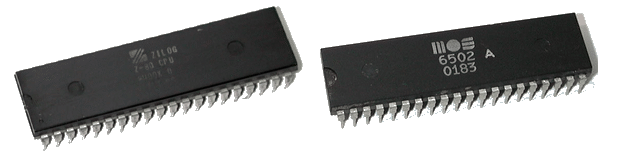
Technically, and unlike the Amiga for instance, the CPC was not the best machine — smooth scrolling remained a challenge — and it was even disappointing on the audio side. But everything was there, and its integrated form, monitor plus computer, was revolutionary and gave that home computer a novel, almost embodied character. In the end, coming from the 6502, discovering the Z80 and what it could do was like a breath of fresh air: the perfect transition from 8-bit to the 16-bit systems that were coming.
Do you still own an Amstrad computer?
In fact I never owned one. The companies lent me systems to program on, so I gave them all back — except my Orics.
What did you use them for?
Mainly to program games.
Which programs did you publish on the Amstrad?
There were:
- Le Bagne de Nepharia, 1985 — France Logiciels.
- Fer & Flamme, 1986 — Ubi Soft.
- L’Anneau de Zengara, 1987 — Ubi Soft.
- B.A.T, 1991 — Ubi Soft (an excellent conversion by Tim McCarthy from the Atari ST version).
How did the design of those games go?
With the exception of B.A.T, I did everything myself — story, programming, graphics and audio — with a hand here and there: I did not write the introduction music for Fer & Flamme, Patrick Daher (Zombi) helped me with one or two drawings in Fer & Flamme, my brother Thierry tested my games, and so on. We also had very little support from publishers, who confined themselves to marketing, minimal at the time, and to duplication. For example there was no testing department at Ubi Soft in those days. In short, we did a bit of everything.
As for me, I wrote a great deal of the ideas and the structure of the game in notebooks. Then I threw myself into the programming and the content in a disjointed way, with no real organisation, until it was done. I would spend whole days coding or drawing graphics, and others doing nothing at all. I once worked nineteen hours straight in a single day, without eating or sleeping. I lived at my parents’, I was a student, and it worried them a little, but I always managed to keep respectable marks at school.
In 1986, after passing my baccalauréat, I entered a large electronics engineering school a fair distance from home and had to get up very early. I went to bed around midnight to push the game forward and got up around five in the morning to go to the school. What shape I was in back then!
Which languages did you use? Did you use any particular programming tools?
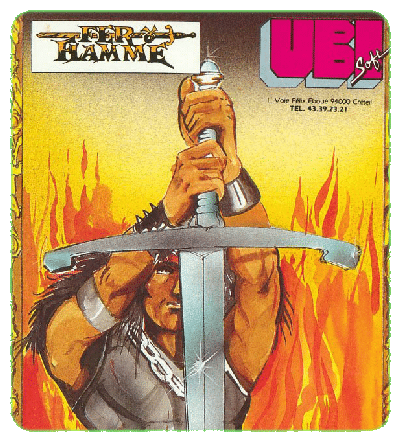
Fer & Flamme was 90% BASIC. Zengara was 100% Z80 assembly, and if I remember rightly with the ZEN assembler-debugger environment. Rodnay Zaks’s big book Z80 Programming quickly became my bible. For Zengara I worked with two CPCs: a colour 6128 for the graphics and a monochrome 464 — that keyboard! — for the programming. Both machines were on the whole time and I moved between graphics and code as the mood took me.
For the graphics I made good use of the excellent Lorigraph on the 464, then a little OCP on the 6128.
Did you run into difficulties? If so, which ones?
With Fer & Flamme I hit serious memory problems. There was little documentation and I realised far too late that the system in ROM used a lot of RAM, especially while loading programs — and Fer & Flamme ran in several parts, which meant several different programs! A few weeks before Christmas, when I had to deliver the game come what may, I had to perform feats to manage that memory. I did not sleep for three days, but I finally found a solution: going through overlay programs.
I swore afterwards that I would only ever write assembly, so as to have better control over the system’s resources.
The game did not fit on the two discs either! I had to change the formatting of the sectors and the gaps, right at the edge of what was acceptable, to get everything in. I remember going to see the duplicator at the last minute to explain my formatting to him so he could set his machines up.
What do you make of the direction computing took with the arrival of the IBM standard?
In video games, one important turning point was the console: systems became proprietary, reserved for professionals. So we went from craft, from authored creation, to industry, to ever-growing teams and mass production. It was less painful in the United States, it seems to me, where developers had already — naturally, I would say — organised themselves into teams. In France the spirit of the “author” was very strong at the time. Another turning point was the CD-ROM, this time on the content side: no more small teams, not with 600 MB of data to fill!
More generally, I remain amazed at the level of complexity computing has been able to reach. But on the other hand, in my opinion that complexity rather hardens the pleasure we might take in working with such power. We now program less close to the silicon and more in the abstraction of software, and increasingly so — not least through the rise of object-oriented programming. So it is not abnormal in itself that we feel less drawn to modern machines; we feel closer, perhaps, to operating systems. Back then, a new and eccentric machine came out every week: who remembers the Jupiter ACE, which you programmed in Forth, or the MO5, or the Squale?
We worked close to those “little” machines, and a strong, almost affectionate bond formed with them. The electronic architecture and the programming language came first; the OS was incidental. I imagine that is the historical and logical course of innovation, and that the first creators of motor cars or aircraft lived through the same crystallisation of passion into industry — somewhat at the expense of the pioneering spirit.
Have you kept in touch with people from the industry of that period?
Not many. I am still in touch with Olivier Cordoleani and a few others, but we see each other very little. André Villard, however, who worked on BAT 1 & 2 and at Haiku, is a close friend.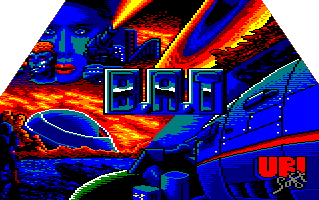
Perhaps a few words for our readers?
It was a blessed time for digital creation and pixel art. Being at once passionate about machines and good at graphics, I was lucky enough to find a medium that could reconcile those two disciplines. We had the feeling of being pioneers. That era is over, but other opportunities are appearing, and my word to you is not to let them pass if you have a creator in you. After a very industrial flattening in the 1990s and 2000s, it seems that new and unprecedented opportunities are opening up, close to the spirit of the eighties.
There is indie, the Steam platform, the Web and the iPhone / Android, which make direct contact between creators and players possible and allow more risk-taking… Angry Birds and Minecraft are examples. So: to your keyboards, ladies and gentlemen!
Interview conducted in March 2011 by NoRecess for Phenix Informatique.