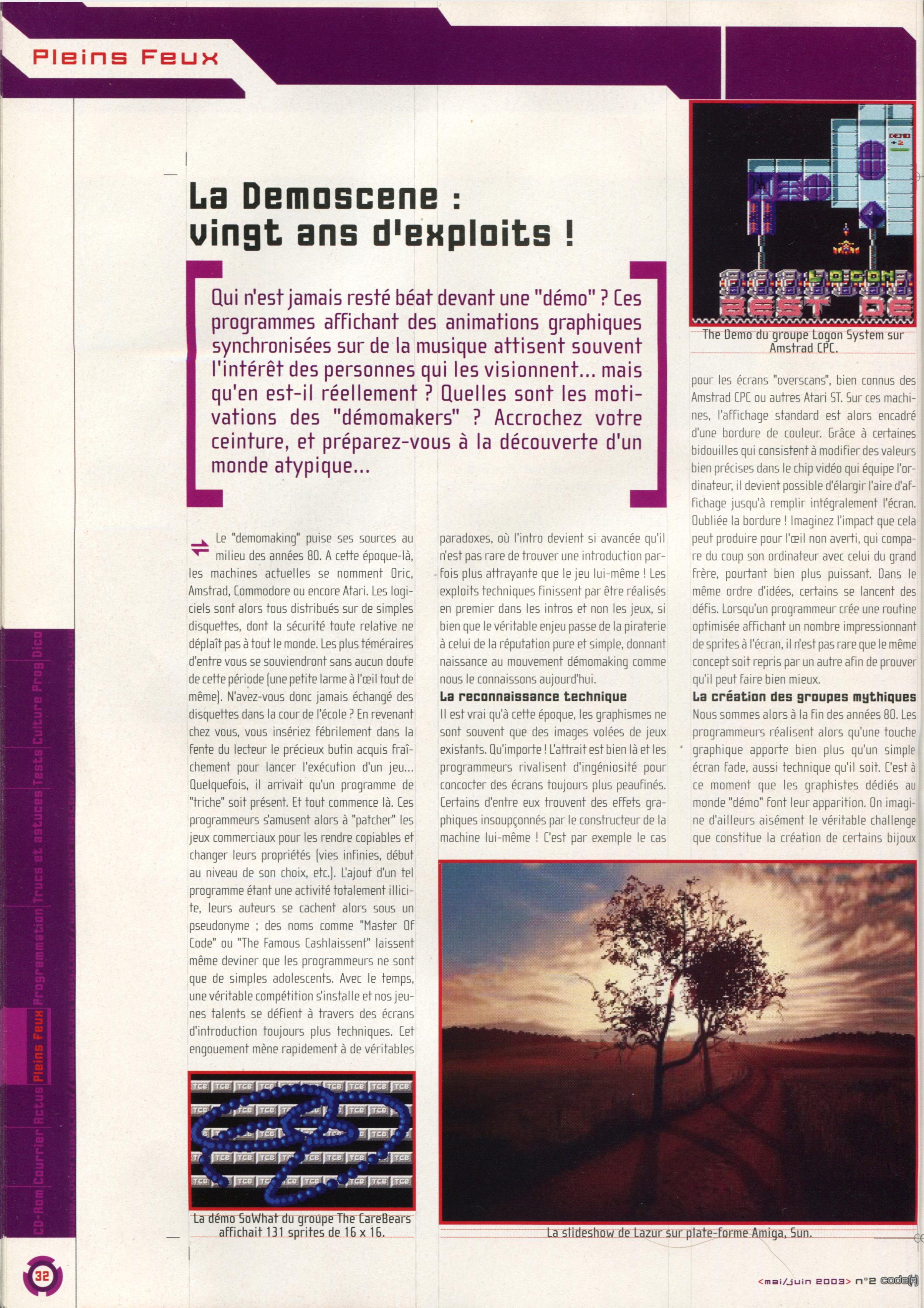
La Demoscene : vingt ans d'exploits !
A feature on where the demoscene came from: cracking screens that grew more ambitious than the games they were attached to, the technical one-upmanship of overscan, and the groups that came out of it.
Between 2001 and 2003 I wrote a great deal for the Code(R) magazine: feature articles, programming courses, reviews and tests, and a fair amount besides. I had to stop there — it was taking too much of my own time, and alongside a day job programming video games it was no longer possible.
A feature on where the demoscene came from: cracking screens that grew more ambitious than the games they were attached to, the technical one-upmanship of overscan, and the groups that came out of it.
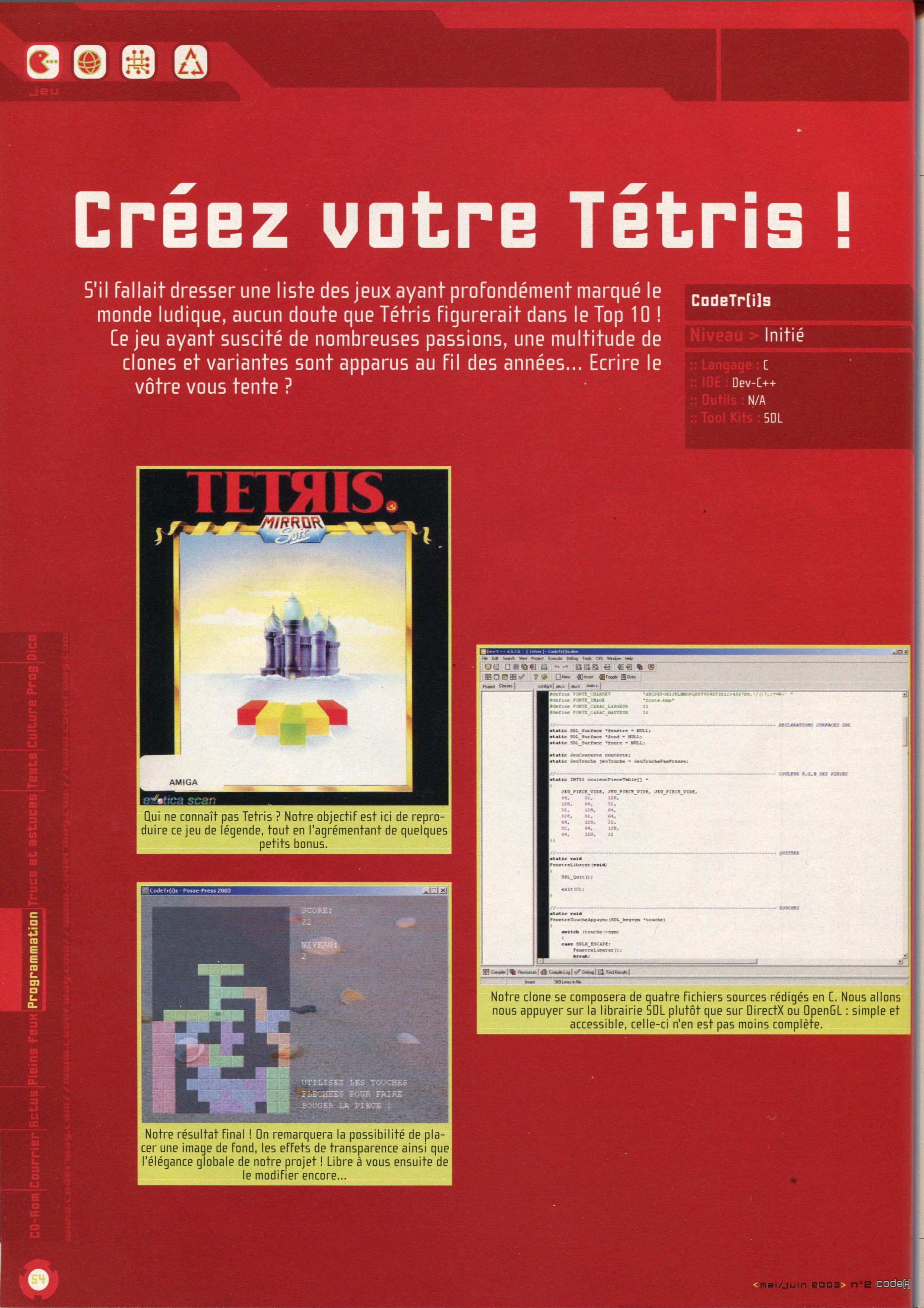
Writing a Tetris clone from nothing, in C over SDL, in four source files. Level: initiated.
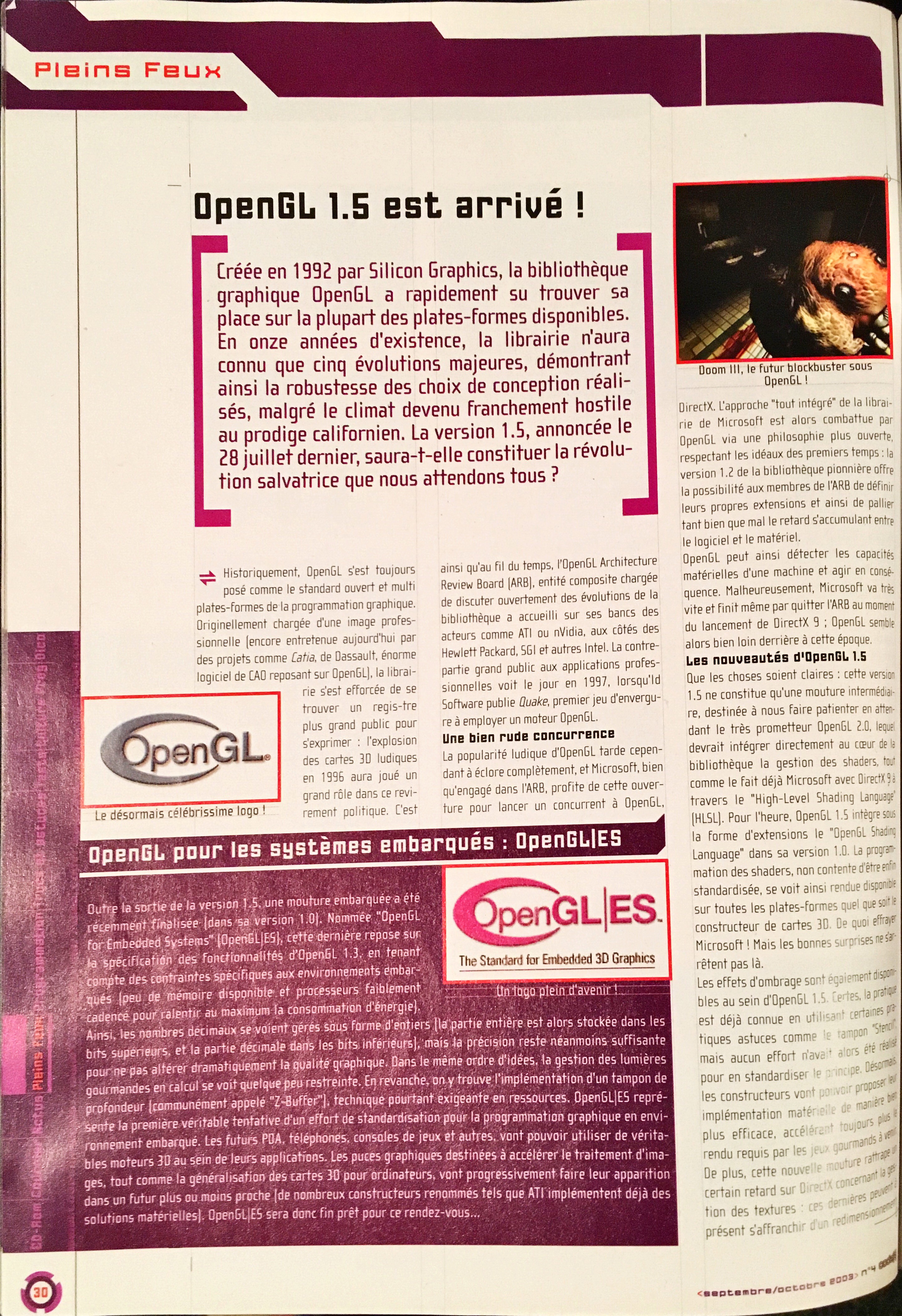
What the 1.5 release of OpenGL changed, and what eleven years and five major revisions say about the design decisions Silicon Graphics made in 1992.
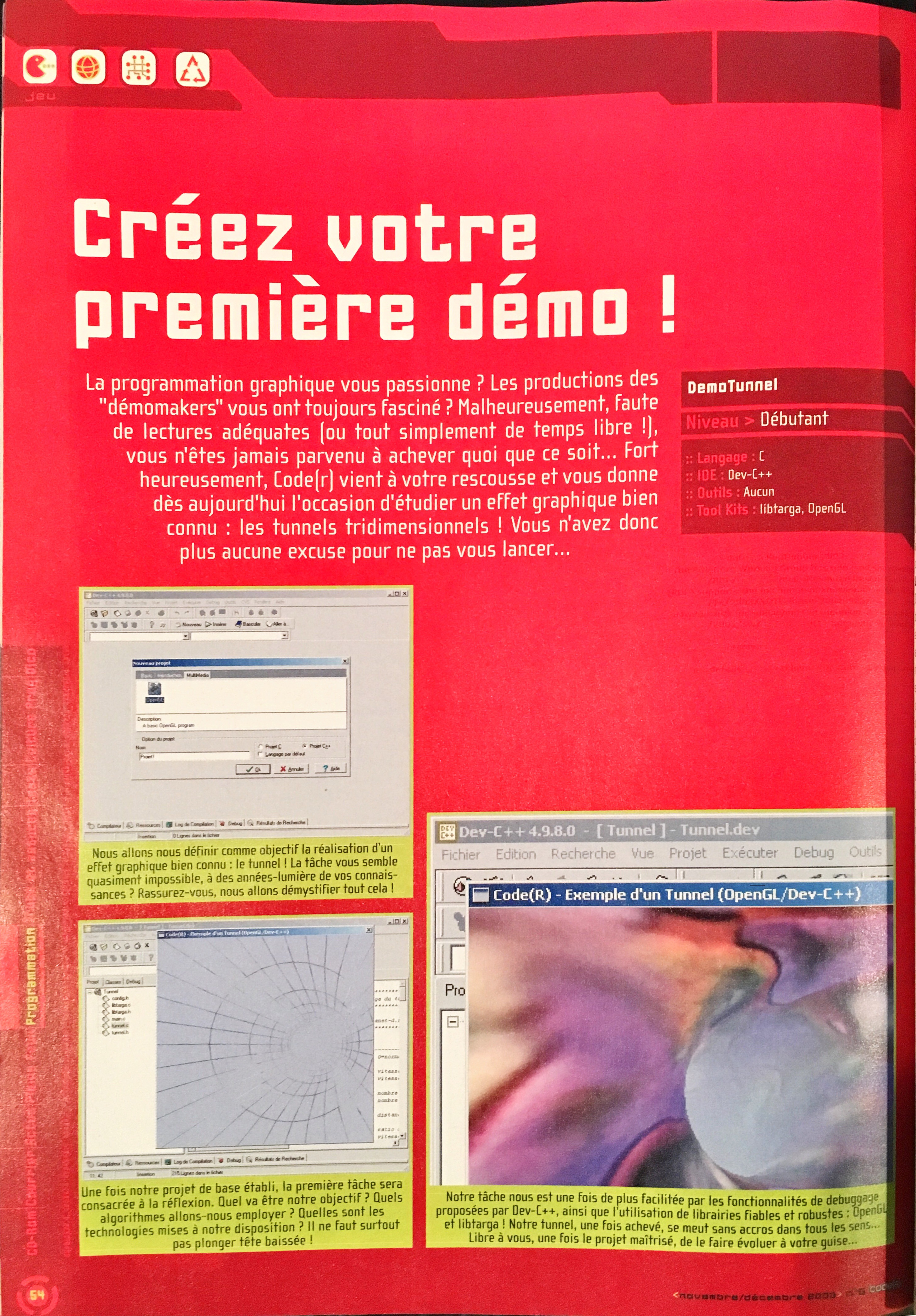
A three-dimensional tunnel, taken apart and rebuilt: the graphic effect everyone starts with, and enough of it to finish something.
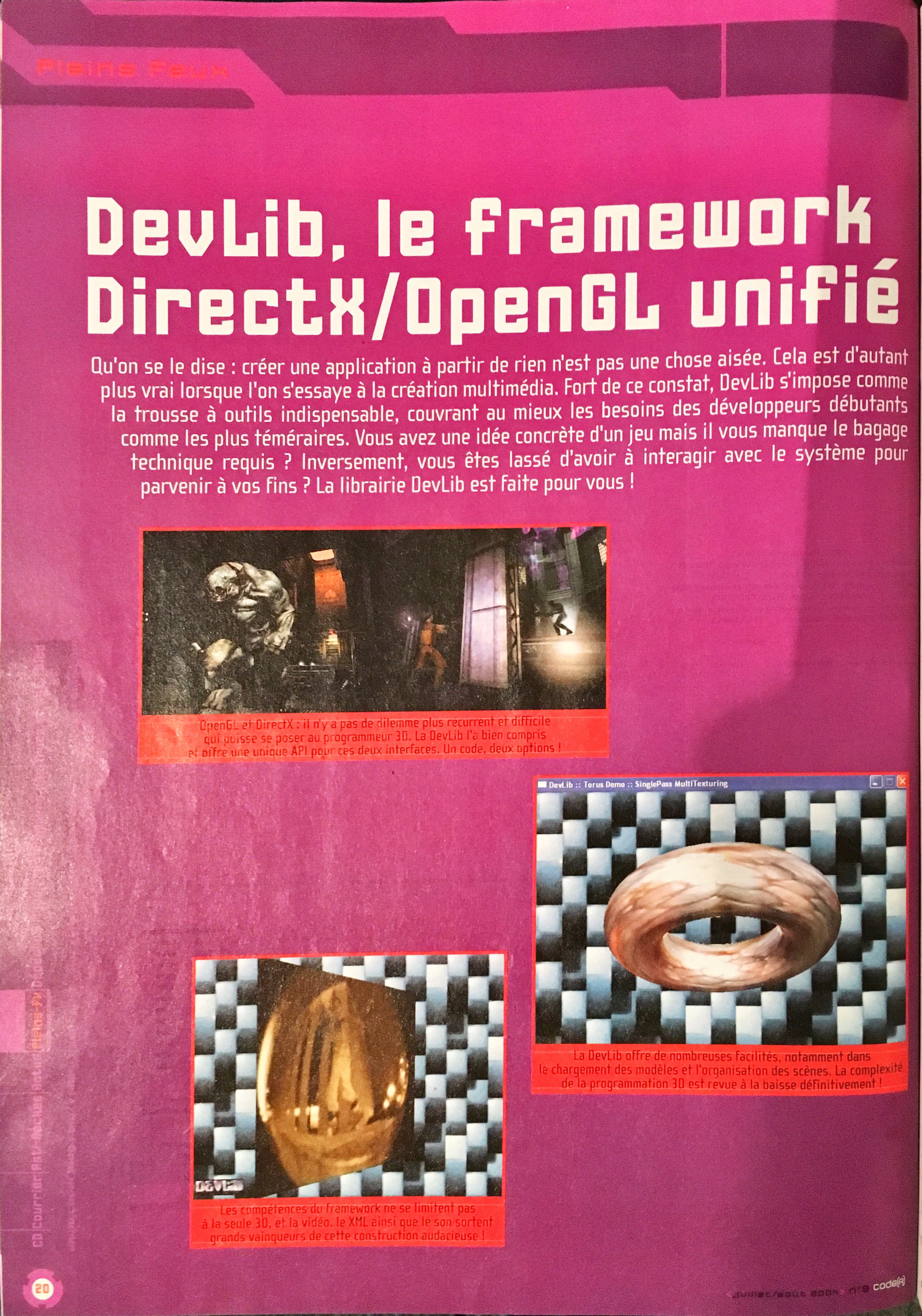
Eleven pages on DevLib, a toolkit that puts one interface over DirectX and OpenGL, so that starting an application does not mean starting from nothing.
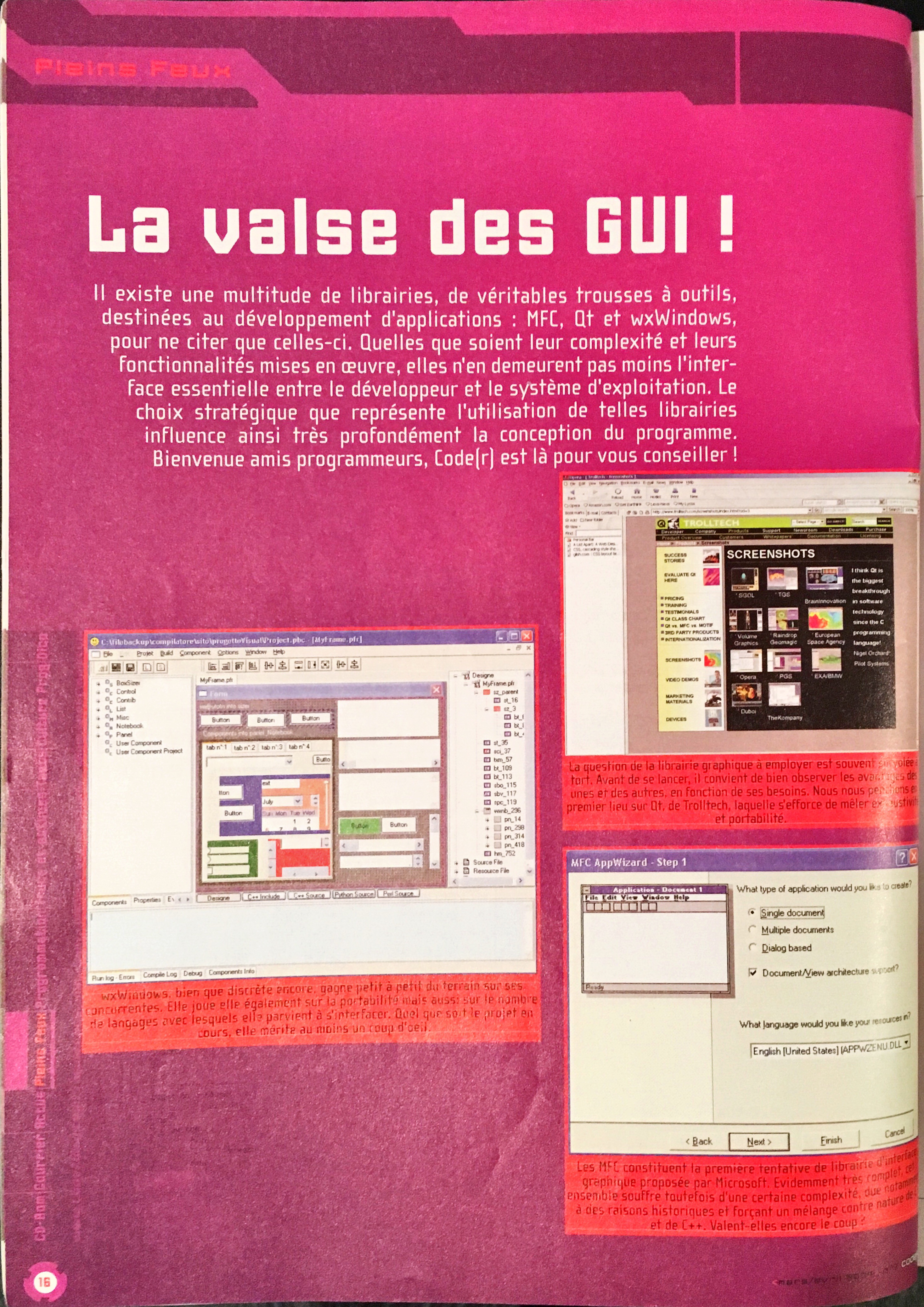
Choosing a GUI library, and living with the choice: MFC, Qt and wxWindows each taken in turn, and what picking one does to the shape of everything built on it.
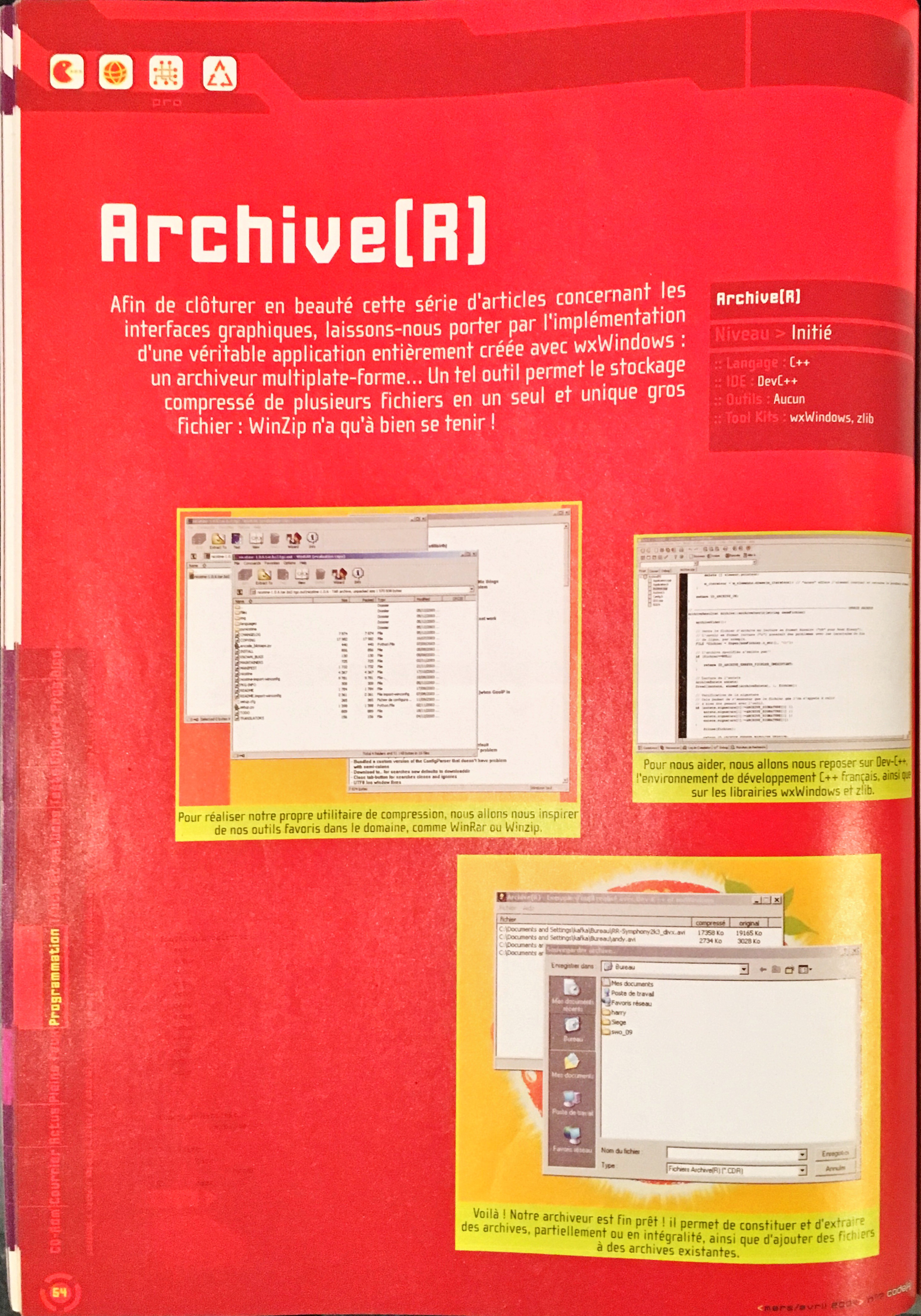
Closing the series on graphical interfaces by building a real one: a cross-platform archiver, written entirely with wxWindows.
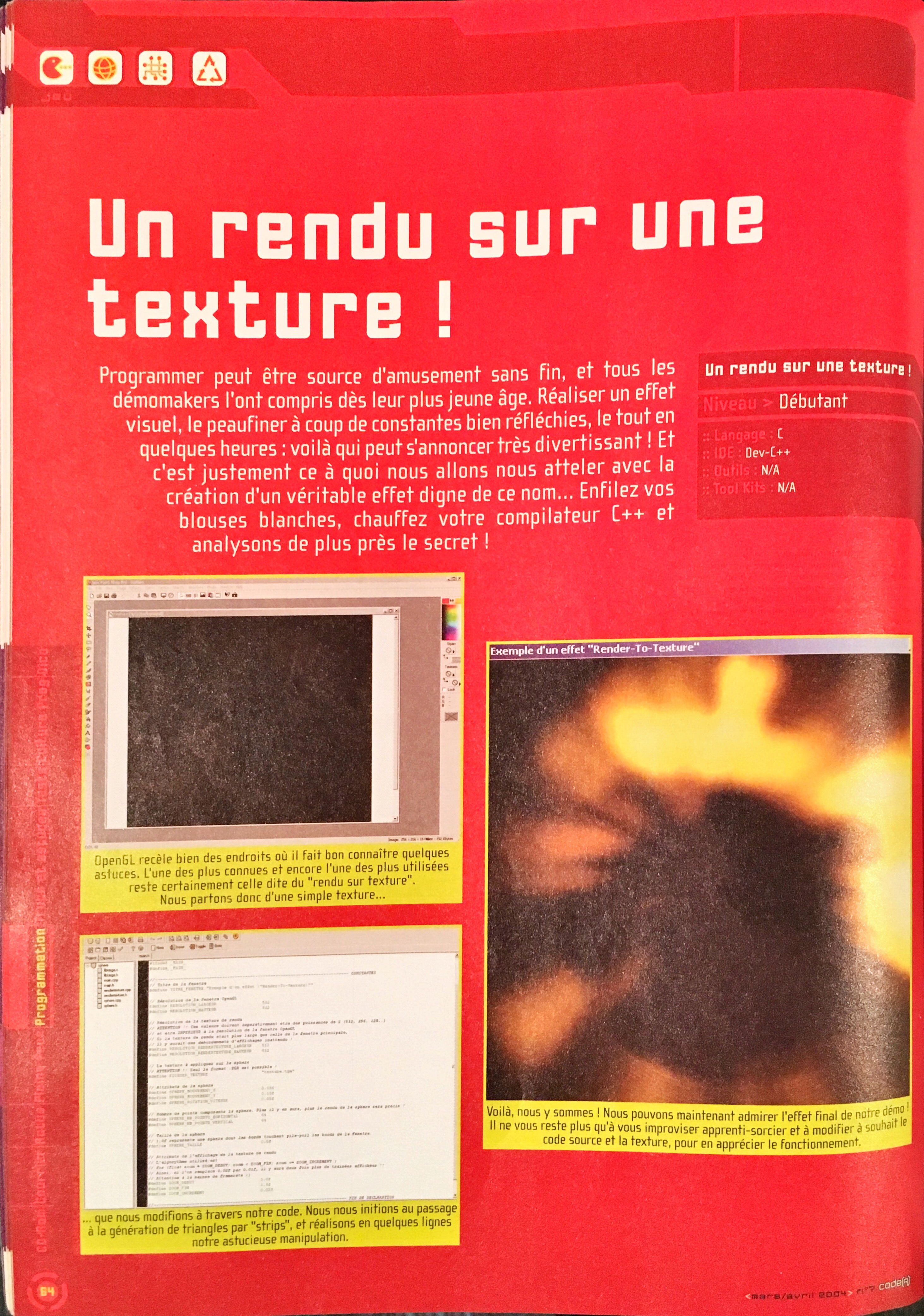
Render-to-texture in OpenGL, from a plain texture to a finished demo effect, in a few hours and a few lines. Level: beginner.
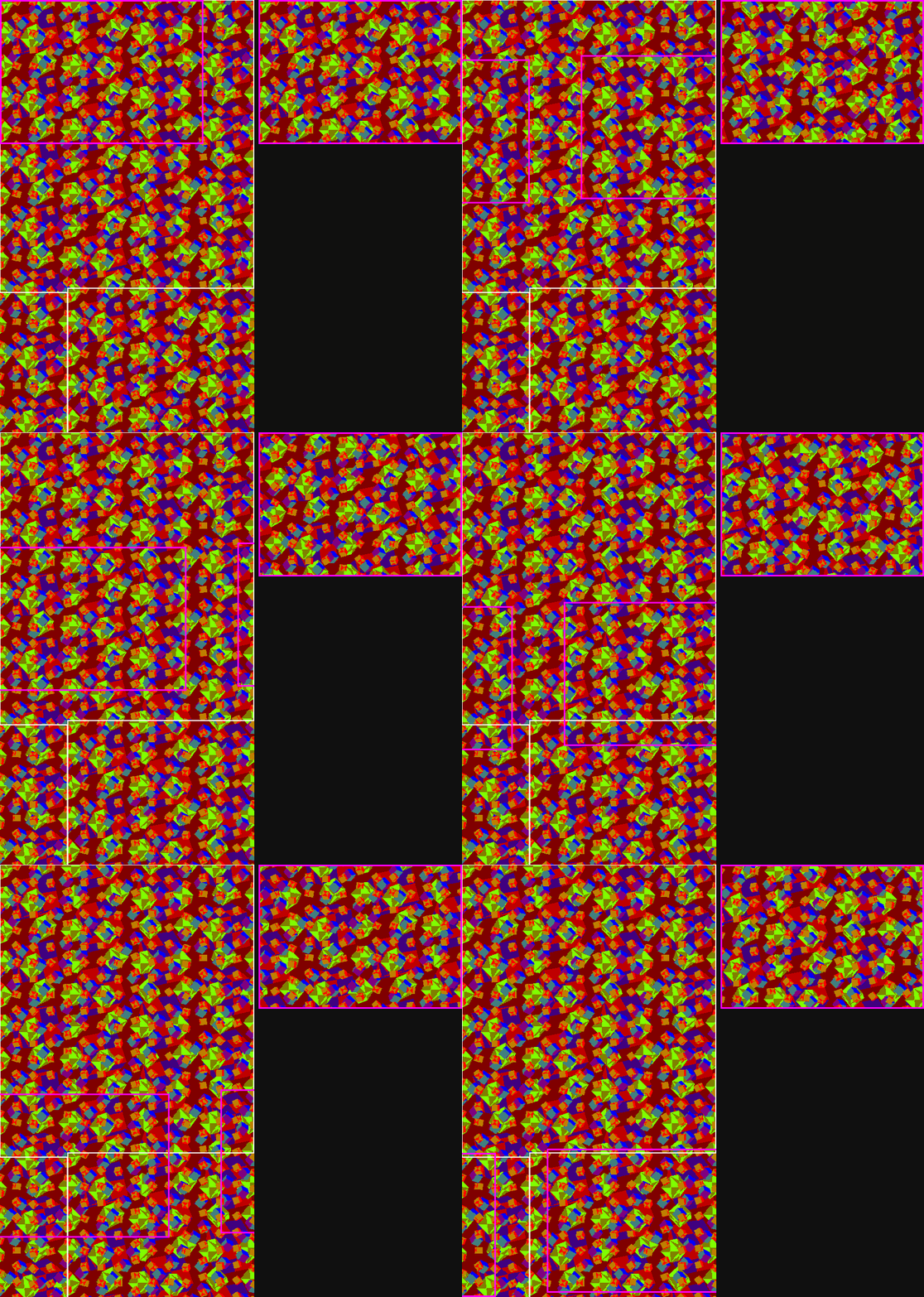
Making of “Logon’s run - 3D meets the aging bits” (released at Revision 2017) by Overflow / Logon System Article written and designed by Overflow / Logon System in February 2017 - Published by NoRecess in April 2017 . Click HERE for demo…
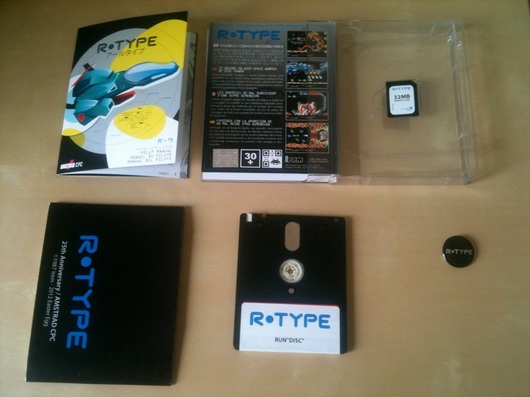
EasterEgg ’s remake of R-Type game is probably one of the most noticeable production that has been made lately. Great reviews of the game itself are already available from multiple sources so this article won’t be another one like others…
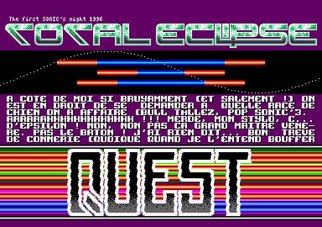
Epsilon / Power System (and Arkos ) has been a prolific creator of demos , magazines and even games ! More than that, he was not only an experimented programmer , but also a great musician AND a skilled graphist ! Does this raise some…
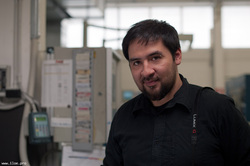
Carlos Pardo , also known as Made / Bomb in the demoscene world, is an highly-skilled graphist on modern platform that initially started on Amstrad CPC . I was curious to know more about him, his history, I asked him for an interview and…

Oliver Mayer , known as BSC / SymbiosiS , is a programmer / musician that is most famous for his work as an audio programmer on Amstrad CPC . He is the author of several demos as also the Soundtrakker ( 1991 ). I was curious to know more…
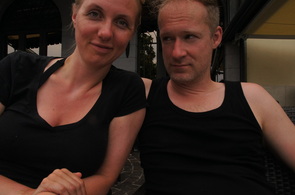
Kalle Rechberg , also known as Thriller / Cadjo Clan , was a demomaker in the early days of the CPC scene , from 1988 to 1991 . I admit his work was not as advertised as some others, but I was definitively curious to know more about him…
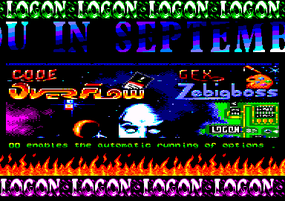
Olivier Gout , also known as Overflow / Logon System in the demo scene, is the programmer of the splendid S&KOH demo ( 1991 ) - one of the most technical demo ever released for the CPC. He also produced other mentionable productions…
Elmar Krieger , also known as Elmsoft / EGS in the demoscene, was a famous programmer active on Amstrad CPC platform. He created some worth-watching demos (including Chain Demo ), but he is better known for the following games: Zap’t’Balls…
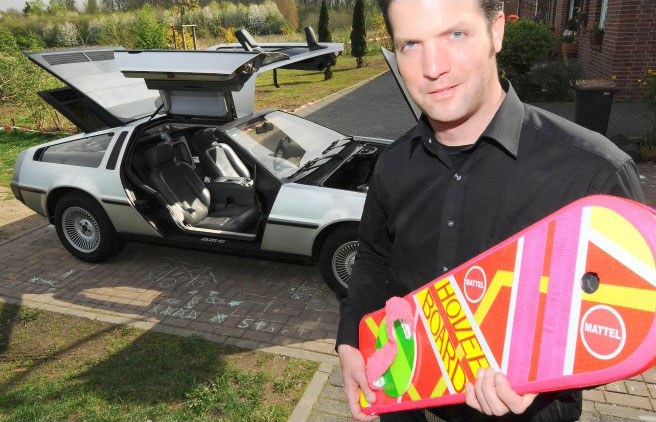
Jörn , also known under the name of Prodatron / SymbiosiS in the demoscene, is famous for his impressive Amstrad CPC productions. During 1993-94, at a time where demos were all about big scrollers and tricky other hardware effects, he…
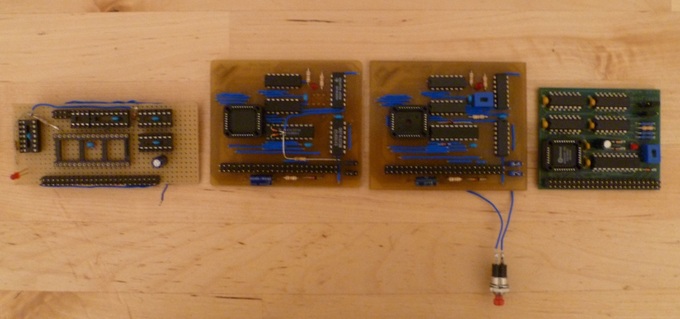
Bryce is an active Amstrad CPC user, that can be reached through the CPCWiki’s forum . Lately, he has released the MegaFlash , which is an amazing extension for the CPC allowing up to 32 ROM s at the same time. I was very curious to know…

Georg Odenthal , better known under the name of Odiesoft , was a very productive programmer back in the early nineties. He produced one major game - Megablasters - as also many innovative visual effects for the time (especially since…

Richard Wilson is well-known for this WinAPE emulator. But his activities related to the Amstrad CPC did not start recently and is absolutely not tied to WinAPE emulator development. Actually he has been quite productive for a long, long…

Serge Querné , better known under the pseudonym of Longshot / Logon System , is considered as the pionner of advanced programming on Amstrad CPC. Productions after productions, he progressively demonstrated how powerful the Amstrad CPC…
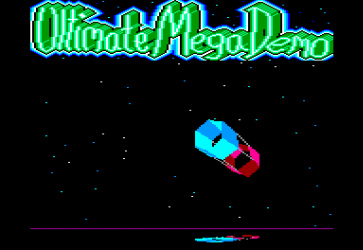
Andreas is actually better known in the CPC demoscene under the name of Face Hugger (in reference to Alien movie). He has been very productive in the beginning of 90s and has demonstrated realtime 3D usage was definitively possible in…
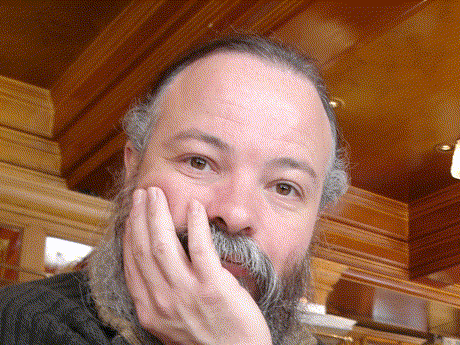
Hervé Lange, author of Le Bagne de Nepharia, Fer & Flamme, L'Anneau de Zengara and B.A.T, looks back on his Amstrad CPC years: the sleepless nights, the memory that ran out, the disc formatting pushed past the limit, and a time when programming meant creating.
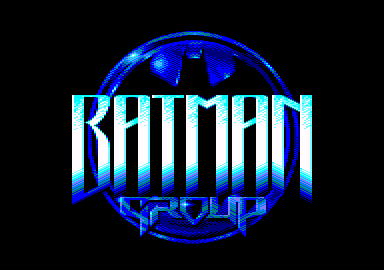
Rhino from Batman Group is the main programmer behind the very impressive Batman Forever demo. I was curious to know more about him, as also get details about this production.. He kindly accepted to answer my questions, hope you will enjoy…
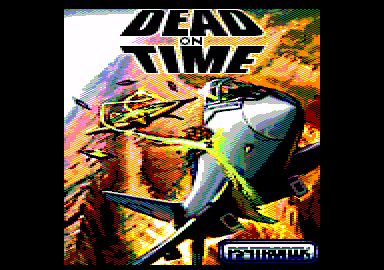
Paul Kooistra , also known as Axelay , is the author of Star Sabre (2007, 2009 for the 128Kb-version), Dead On Time (2010) and Sub Hunter (2011). He is one of the most productive game programmer for the Amstrad CPC. I was curious to know…
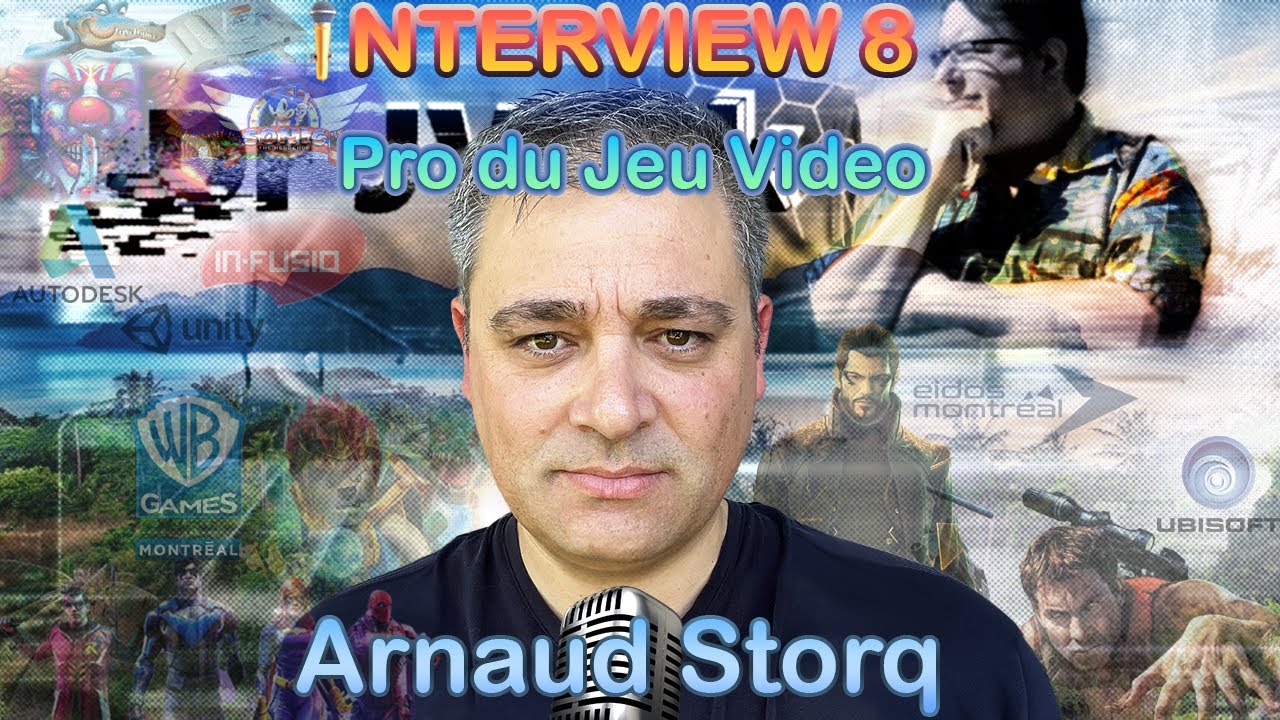
On 7 August 2024 I spent four hours and forty-eight minutes live with Dr JVtek, retracing the whole thing: the CPC my brother got for Christmas 1988, In-Fusio and a CV with a virus on it, Far Cry squeezed into 64 megabytes, Deus Ex, LEGO, Autodesk, Unity, Gotham Knights — and the evenings still spent writing Z80. The conversation in full, in twenty chapters.
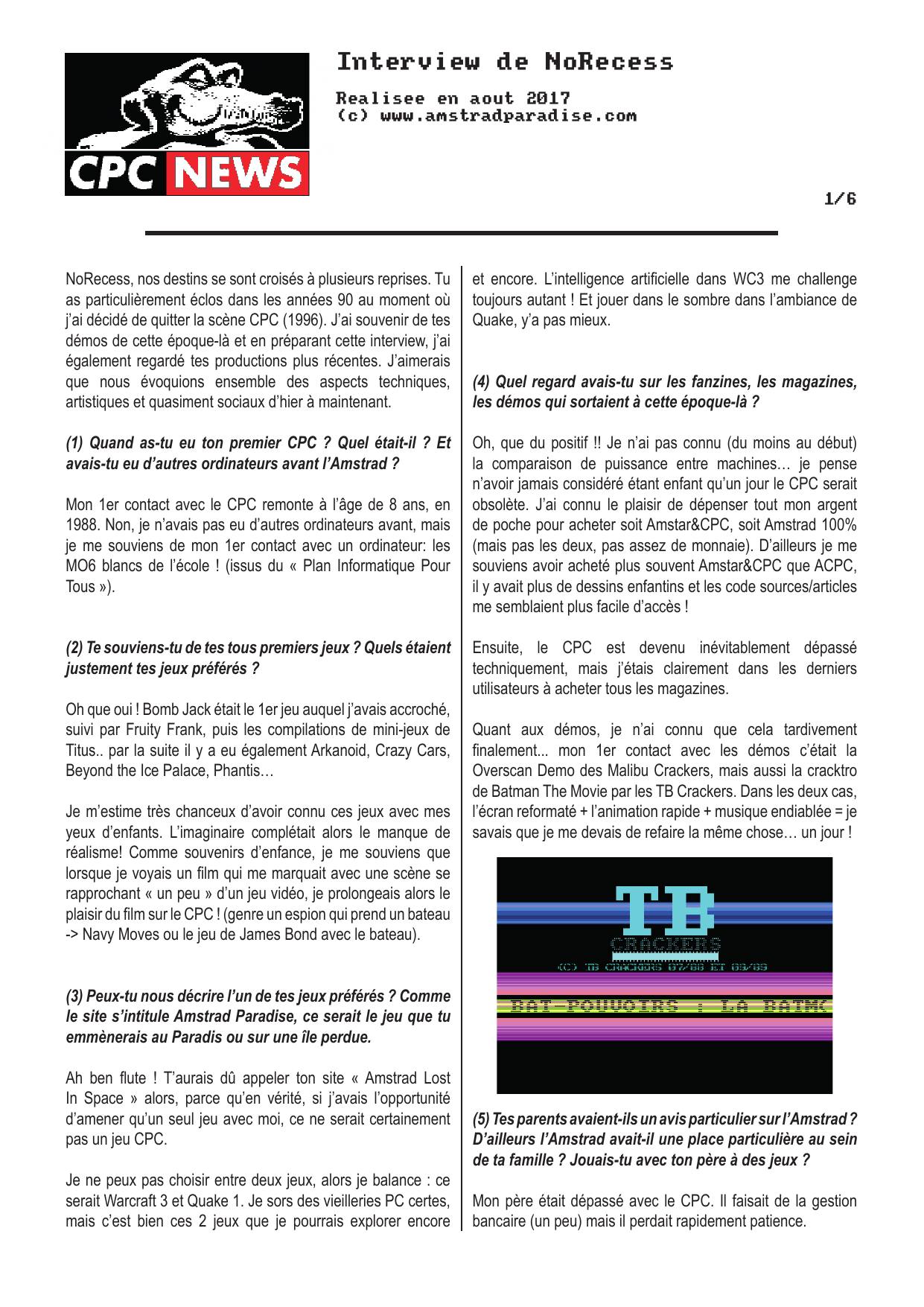
Epsilon turned the tables in August 2017 and put twenty-one questions to me for Amstrad Paradise. The six pages of the interview, as they were published.

Three weeks after Phortem came out, FenriX put seven questions to me for OrdiRétro: why write a demo for the CPC in 2013, how the code actually gets written, which effect took three rewrites, and what thirty years of the machine had left to find. The whole exchange, as it was published.
Two years after Phat brought me back to the Amstrad CPC, Hicks asked me eight questions for Push'n'Pop: the eleven-year-old amazed by Malibu Demo 4, the maxidemo lost to a READ FAIL, the ripped code I was reproached for at fourteen, and why a C compiler on a Z80 was worth the trouble. The whole exchange, as it was published.
No matching content.